
When a website needs to become part of how the business operates.
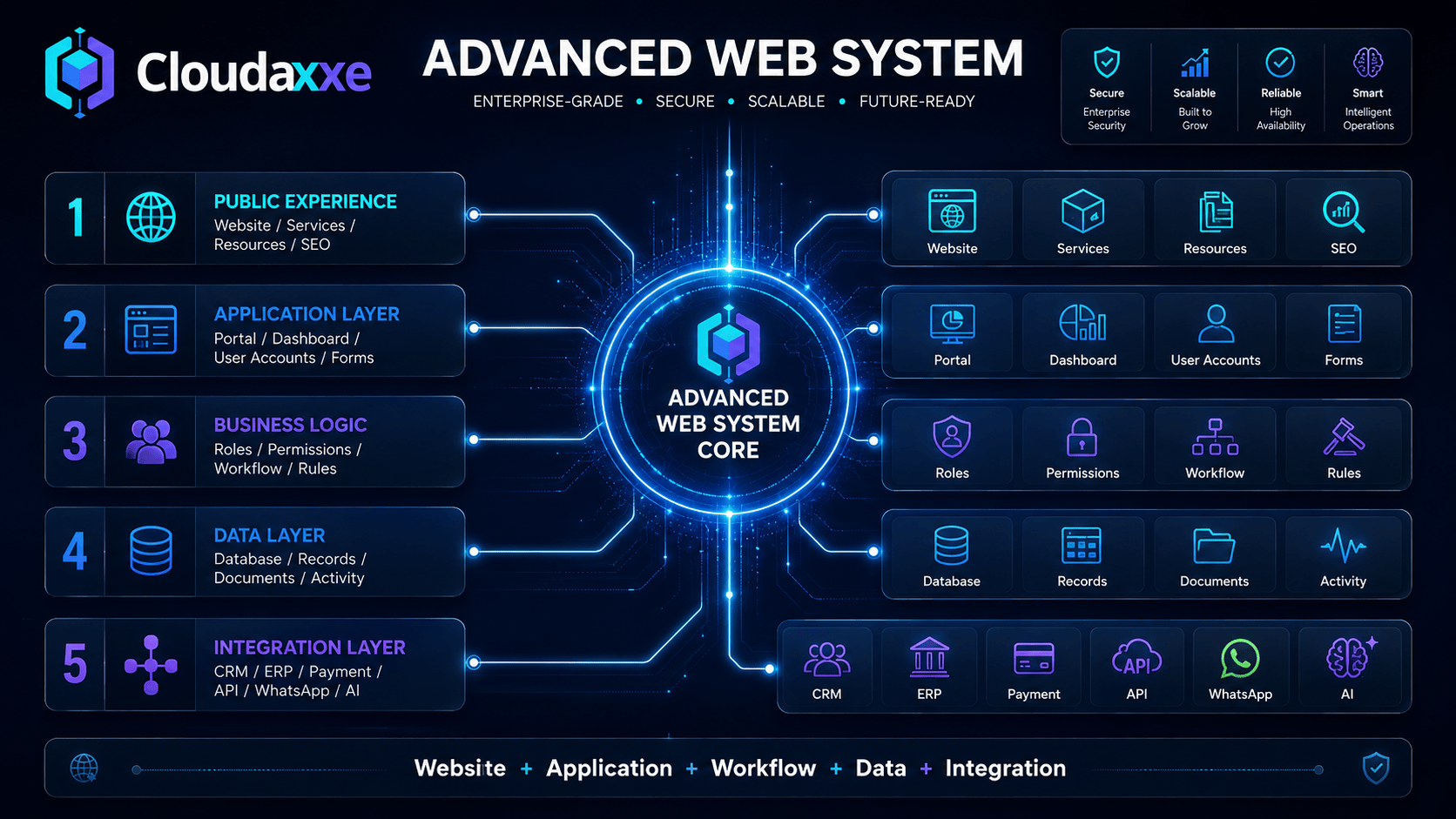
Advanced Web System is for projects that need more than pages, forms and a CMS. It combines bespoke interface design with application logic, user access, workflows, structured data and integrations around the way the business actually works.
Starting point for a scoped Advanced Web System project.
No fixed page allowance or predefined feature bundle.
Custom-coded, headless or hybrid where appropriate.
Working days for a typical project.
Reviews happen at defined project stages.
Post-launch technical support for the agreed implementation.
Some requirements are not page requirements. They are system requirements.
A conventional website is mainly built to present information, support discovery and generate enquiries. An Advanced Web System starts when the project also needs to manage users, permissions, data, workflow, transactions or integration with other business systems.
B2B Authority helps people evaluate the business. Advanced Web System can also manage what happens next.
The jump from RM13,500 to RM20,000+ is not about adding more pages. It is about moving into application logic, operational workflow and connected data.
Authority infrastructure
Digital system infrastructure
Build around the business process, not around a predefined feature list.
Every Advanced Web System starts with the operational requirements of the project. The final architecture may combine public website content, authenticated user areas, internal tools, data, workflows and third-party systems.
Identity, Roles & Permissions
User accounts, login flows, access levels and role-based functionality where required.
Portal & Dashboard
Client, customer, partner or internal dashboards built around the agreed workflow.
Database & Records
Structured records, relationships, submissions and application-specific data models.
Custom Workflow
Submission, review, assignment, approval, status and completion logic.
API & Integration
CRM, ERP, payment gateways and supported external platforms.
Automation
Notifications, routing, status updates and selected email or WhatsApp workflows.
Admin & Operations
Custom operational controls, user management and data management interfaces.
Marketing Website
Public services, SEO pages, resources and conversion routes can remain part of the same architecture.
Different users can require different access, actions and information.
Login is only the first step. The useful part is what a user can see, what they can change, and what the system does with those actions.
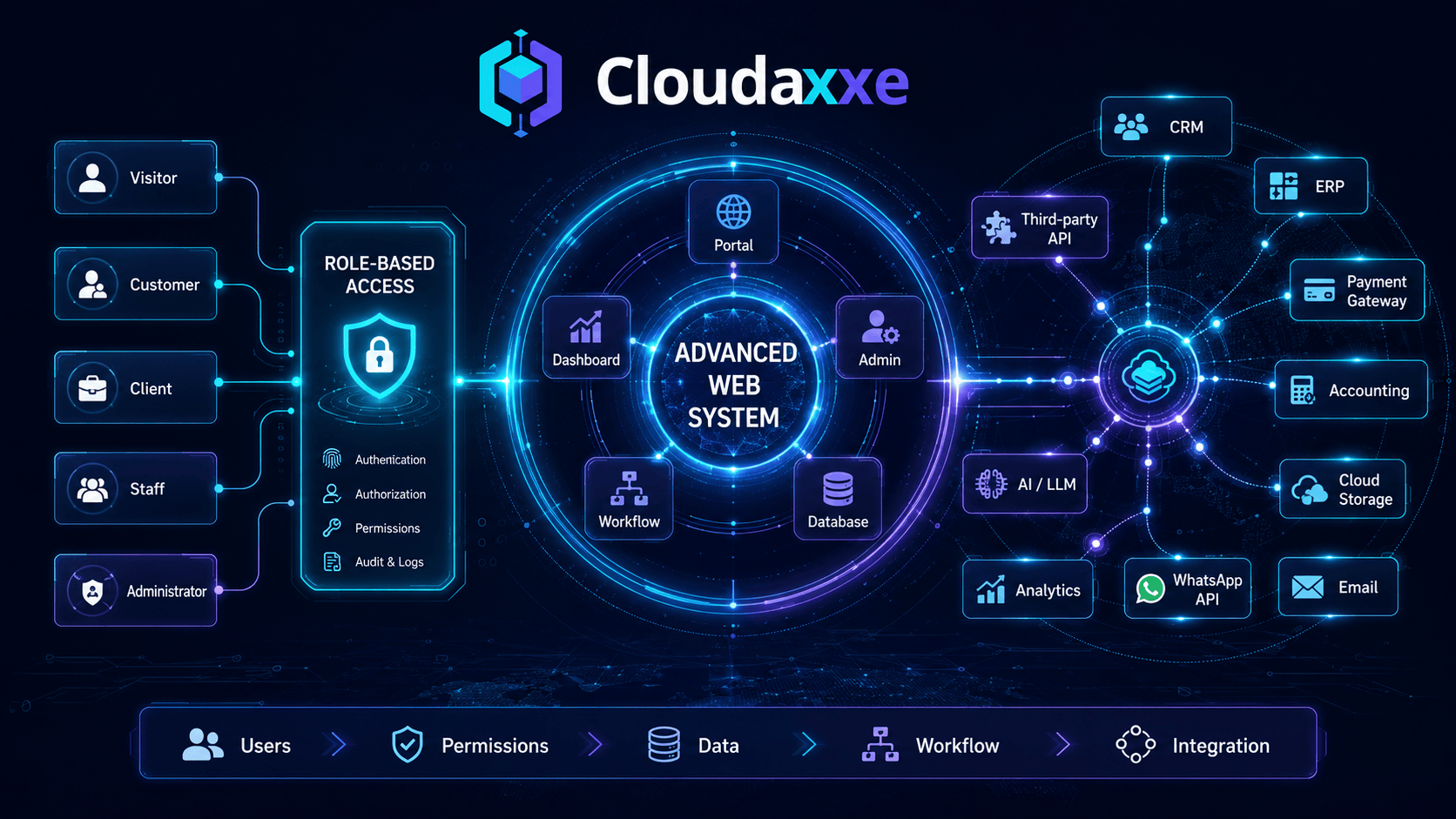
Give each user the information and actions relevant to their role.
Dashboard scope depends on the data sources, calculations, workflow logic and integrations required by the project.
Client Portal
Project status, requests, documents, account details and relevant actions.
Internal Dashboard
Assigned work, records, approvals, status changes and operational actions.
System Administration
User control, system settings, workflow oversight and data management.
The interface is one layer. The data model determines what the system can actually do.
Where structured application data is required, the system is designed around records, relationships and business rules rather than treating everything as ordinary website content.
Turn a manual process into a defined digital flow.
Workflow logic is designed around the real operating process. A project may need approvals, assignments, status changes, notifications, document handling or conditional actions.
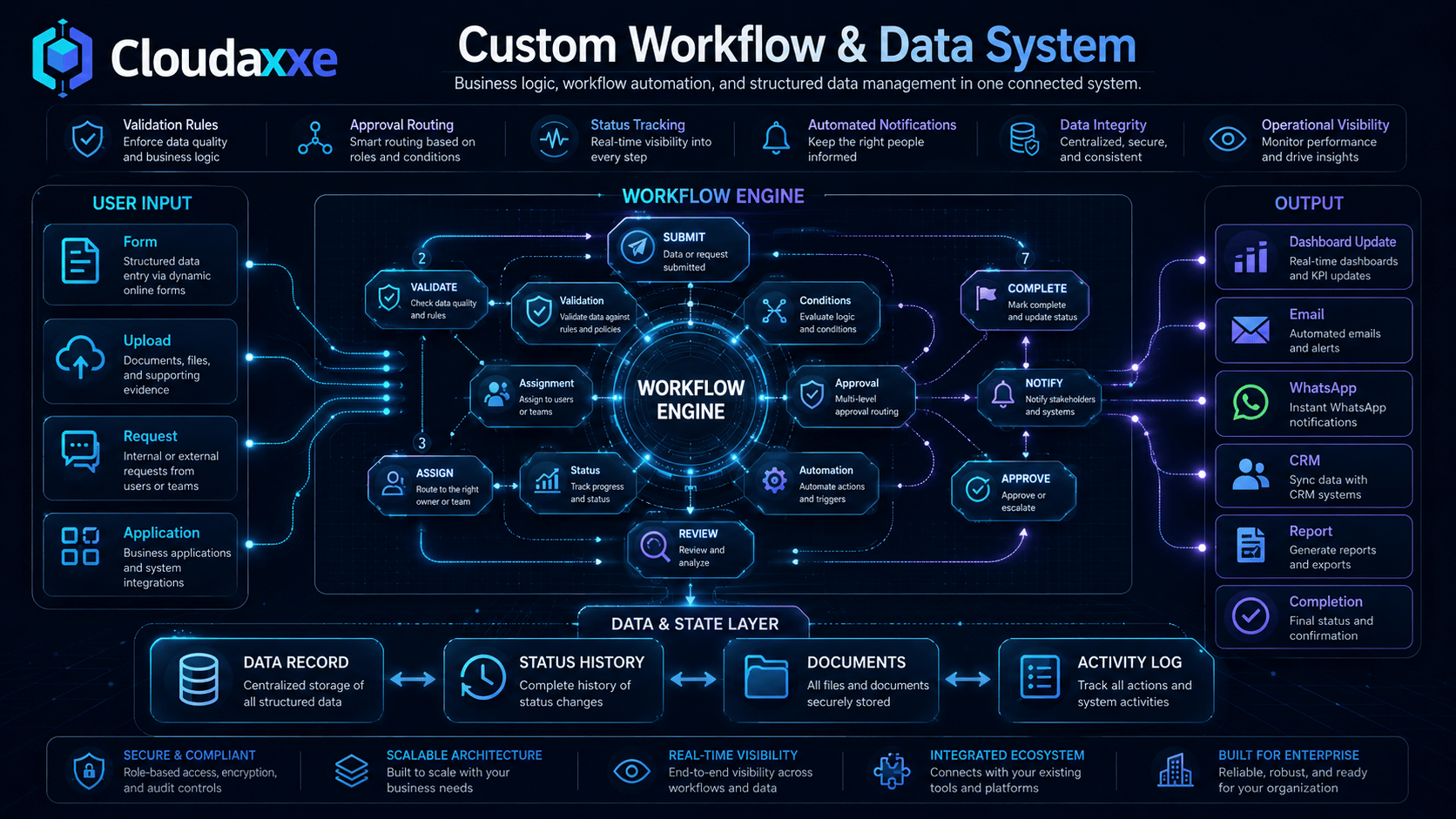
The web system does not have to operate in isolation.
Integrations are assessed individually because API quality, authentication, rate limits, available data and third-party restrictions can materially affect implementation.
Customer Data
Lead, contact or account data where a supported CRM allows integration.
Operational Systems
Selected business data or workflows where the source system exposes suitable access.
Payment Gateway
Payment collection or transaction flows where appropriate to the project.
Third-party Platforms
Cloud storage, email, messaging, analytics or other supported APIs.
Use automation where it removes repetitive work.
Automation is useful when it moves a real process forward. It should not be added simply because an integration is available.
The operational team may need its own tools too.
Where required, the project can include custom administration interfaces built around the information and controls the team actually uses.
User Management
Manage accounts, roles, access and account state.
Operational Data
Manage projects, requests, submissions, files or custom records.
Workflow Management
Approvals, status, assignment, settings and operational actions.
A system can still have a strong public-facing website.
Advanced Web System can combine application functionality with marketing pages, service content, resources, SEO architecture and conversion routes.
| Layer | Purpose | Status |
|---|---|---|
| Public Layer | Search, services, solutions, resources and conversion. | PROJECT-BASED |
| Application Layer | Login, portal, dashboard and workflow. | PROJECT-BASED |
| System Layer | Database, API, automation and business logic. | PROJECT-BASED |
Design the interface around tasks, information and decisions.
Application requirements are not forced into a conventional website template. Screens and components are designed around what each user needs to do.
Website Interface
Marketing, service, resource and conversion layouts.
Application Screens
Tables, cards, filters, status states and task-focused views.
Input & Workflow
Forms and actions designed around the actual business process.
Device Behaviour
Interfaces adapted for desktop, tablet and mobile use.
Technology is selected according to the project requirements.
The stack is confirmed after the functional, data and operational requirements are understood.
WordPress / CMS Architecture
Suitable for content-heavy projects where an established CMS remains appropriate.
Headless Architecture
Useful where the front end and content or data layer benefit from separation.
Custom Application Architecture
For projects that require bespoke backend logic, workflows or data models.
Plan security around the type of data and access the system requires.
Security measures depend on what the application stores, who can access it and how sensitive the workflow is.
Authentication
Account access and login controls appropriate to the project.
Role Access
Controls around what different users can see and do.
Input Controls
Validation and handling for application inputs and forms.
Environment & Backup
Deployment, backups and environment separation where applicable.
Track the application actions that matter to the project.
Measurement can extend beyond marketing conversions to include useful application and workflow events.
Registration
Submission
Approval
Workflow Completion
Application functionality does not remove the need for discoverable public content.
Where the project includes indexable public pages, technical SEO, information architecture and GEO / AI Search foundations can be incorporated into the public-facing layer.
| Area | Approach | Status |
|---|---|---|
| Public Pages | Indexable service, solution, resource and marketing content. | SUPPORTED |
| Technical SEO | Architecture, metadata, crawlability and structured data where relevant. | SUPPORTED |
| GEO / AI Search | Clear public entity, service and expertise structure where applicable. | SUPPORTED |
| Private Areas | Authenticated portals and dashboards remain outside public search indexing. | PRIVATE |
Complex systems begin with requirements, not screens.
The agreed Statement of Work becomes the reference point for development scope, responsibilities and acceptance.
Business Process
What happens today and what needs to change.
Roles & Permissions
Who uses the system and what each role needs.
Records & Relationships
What information is stored and how it connects.
External Systems
APIs, payments, CRM, messaging and other dependencies.
Architecture, development and testing happen in stages.
Requirements
Confirm users, process, data and constraints.
System Design
Define data, workflow, roles and technical structure.
Flows & Screens
Plan how users move through the system.
Interface System
Design the reusable visual and interaction components.
Development
Develop the agreed front-end and backend scope.
Connected Systems
Implement agreed APIs, payments or automation.
Testing
Review functionality, responsive behaviour and key workflows.
Launch & Handover
Deploy, document and hand over the agreed project assets.
Reviews happen around meaningful project milestones.
Architecture, UI/UX, core development, integrations and pre-launch UAT are reviewed at agreed stages rather than through a fixed number of ordinary website revision rounds.
Changes that materially alter previously approved requirements, workflows or system architecture may require a revised scope and quotation.
70% Deposit → 30% Before Final Handover
70% — Project Commencement. Confirms the project and covers discovery, architecture, design and development commencement.
30% — Before Final Handover. Payable before final production handover, credentials, documentation and agreed project assets are released.
Add specialist modules only where the project needs them.
Advanced Web System starts from RM20,000. These items are examples of separately scoped extensions and are not automatically included in the starting price.
System Modules
Integrations
Data & Migration
Interface Extensions
System Modules OPTIONAL
Integrations OPTIONAL
Data & Interface OPTIONAL
Infrastructure is selected around the application requirements.
Final infrastructure cost depends on traffic, storage, database, deployment, security and application requirements.
Suitable Client Environment
Client-controlled infrastructure can be used where it meets the technical requirements of the project.
Custom Infrastructure
Managed application hosting, database hosting, CDN, staging, backups, monitoring or file storage as required.
Take over the system, or keep Cloudaxxe involved.
There is no compulsory maintenance plan. The included 60-day support period covers implementation-related issues within the agreed scope.
No Maintenance Plan
Advanced System Care
The first 60 days are part of the delivery process.
Advanced Web System includes 60 days of post-launch technical support for implementation-related issues within the agreed project scope.
New features, changed requirements, third-party platform changes and external API changes are outside the included support scope.
Capabilities shown are not a single bundled feature list.
Advanced Web System starts from RM20,000. Features shown on this page represent capabilities that may form part of an Advanced Web System project. They are not all automatically included in the RM20,000 starting price.
Final pricing depends on system complexity, user roles, workflows, integrations, data requirements, infrastructure, security requirements and the agreed delivery scope.
The completed system should remain a client business asset.
The agreed application, website, access and project assets are handed over so the client is not unnecessarily locked into an agency relationship.
Third-party APIs, frameworks, libraries, SaaS platforms and licences remain subject to their respective terms.
Application / Website
The completed agreed system scope is handed over to the client.
Domain
Client ownership and access where applicable.
Admin
Administrative access is provided where supported.
Database / Data
Client-controlled access where applicable to the chosen architecture.
Infrastructure
Relevant hosting or deployment access where applicable.
Analytics
Relevant measurement access where configured.
Project Assets
Agreed source or project assets according to the Statement of Work.
Technical Notes
Documentation is supplied according to the agreed project scope.
Questions teams usually ask before scoping an Advanced Web System.
Is RM20,000 the final price?
No. RM20,000 is the starting project investment. Final pricing depends on the agreed system requirements and complexity.
Does RM20,000 include every feature shown on this page?
No. The page shows capabilities that can be included in an Advanced Web System project. The final feature set is defined in the agreed scope.
Can you build a client portal or dashboard?
Yes, where portal or dashboard functionality is included in the agreed project scope.
Can different users have different permissions?
Yes. Role-based access and permission logic can be developed where the project requires it.
Can the system use a custom database?
Yes, where structured application data and relationships are required.
Can you integrate third-party APIs?
Yes, subject to the external platform, API quality, access method and agreed scope.
Can payment gateways be integrated?
Yes. Payment gateway integration can be separately scoped where appropriate.
Can WhatsApp API be integrated?
Yes. WhatsApp Business Platform integration and automation can be separately scoped.
Can AI be integrated?
Yes, depending on the use case, data, model requirements and operational risk. AI / LLM integration is separately scoped.
Can WordPress be used?
Possibly. WordPress, headless architecture, custom application development or a hybrid approach may be used depending on the requirements.
Can the project include public SEO pages?
Yes. Public marketing and search content can form part of the same architecture, while private portal areas remain outside public indexing.
How long does development take?
A typical project is planned around 30–60+ working days. Larger scopes, third-party dependencies and requirement changes can extend the schedule.
How are revisions handled?
Through milestone-based review. Material changes to approved requirements or architecture may require a revised scope and quotation.
What is the payment structure?
70% deposit at project commencement and 30% before final handover.
Who owns the completed system?
Client-owned handover applies to the agreed project scope, subject to third-party software, API, library and licence terms.
Start with the business process. Then design the system around it.
Tell us what users need to do, what information the system needs to manage and where the current process creates friction. We will determine the right architecture for the project.