
Start selling with a store that can handle real transactions.
A practical first ecommerce setup for businesses moving beyond manual orders. Products, checkout, payment, order handling, search foundations and measurement are put in place as one working store.

One-time implementation fee.
Initial products populated.
Categories or collections.
Standard content pages.
Typical working days.
Post-launch support.
A first ecommerce build for businesses that are ready to sell through a proper store.
Ecommerce Launch suits a straightforward retail model. If the project needs B2B pricing, multiple markets, custom workflows or heavy integrations, a larger commerce package is a better fit.

Move manual orders into a proper store.
Orders are still coming through WhatsApp, Facebook or Instagram and being handled manually.

Put the full buying path in one place.
A first proper online store with products, checkout, payment and order handling in one place.

Organise the catalogue around day-to-day selling.
For an SME or product brand that needs a proper catalogue, checkout and order-management setup.
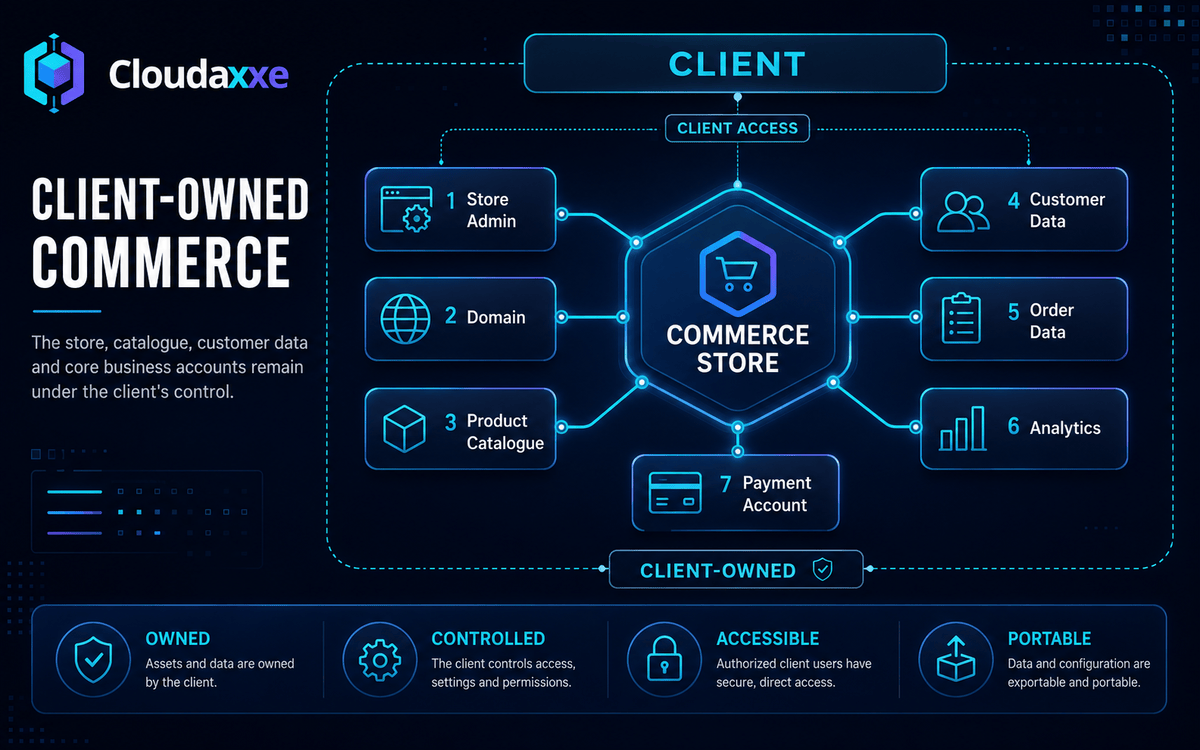
Keep control of the commercial asset.
The store, catalogue, customer data and core business accounts remain under the client’s control.
The project covers the transaction path, not just the storefront.
The store is planned around what needs to happen from the first product view through to a recorded order.
Find
Navigation, collections and search help customers reach the right product.
Evaluate
Price, images, stock, variants and product information support the decision.
Review
Items, quantities and applicable discounts are checked before checkout.
Confirm
Customer, delivery and payment details move into the transaction.
Pay
The selected standard gateway handles the payment flow.
Operate
The order is recorded for processing, fulfilment and customer updates.
The platform should fit the business, not the other way around.
We look at where you sell, how you take payment, how the catalogue is structured and what the team needs to manage after launch. The platform is chosen from there.







Enough scope to launch a proper first store without turning the project into a custom system build.
Limits refer to Cloudaxxe’s initial implementation work. They are not the technical product or page limits of the selected platform.
Initial Products
Core Content Pages
Payment Gateway
Working Days
Core pages are counted separately from the commerce system pages.
The page allowance covers standard business content. Product entries, collections and system-generated commerce pages are handled separately.
Catalogue scope is based on complexity, not an arbitrary SKU cap.
Standard size, colour, material and similar variants are handled flexibly. The work changes when every SKU needs its own content, media, pricing or logistics rules.
Initial catalogue population
Up to 30 parent product listings are prepared and populated using the agreed product data.
Basic catalogue structure
Products are organised into up to five categories or collections for browsing and navigation.
Size, colour and similar options
A catalogue such as 30 products × 5 sizes × 2 colours can reasonably create around 300 standard SKUs without being treated as 300 separate products.
Good product setup starts with usable source information.
Cloudaxxe handles the initial store population and formatting. The client remains responsible for the accuracy of the commercial and product information supplied.
Checkout is only useful if the order can be paid for and managed afterwards.
The base scope covers one straightforward transaction model for one primary market.
1 Standard Gateway
Connection, standard settings and basic payment-status verification using an approved client merchant account.
Up to 3 Rules / Zones
Flat rate, free shipping, basic geographic zones, order-value rules or pickup where supported.
Basic Configuration
Tax display and standard platform settings for one primary market using client-supplied or approved information.
Standard Management
Stock quantity, variant inventory, sold-out behaviour, low-stock settings and basic order status handling.
Keep the first store useful without loading it with features it does not need yet.
The base experience covers the normal customer journey and basic retention tools available through the selected platform.
Customer Account
Registration, login, password reset, addresses and order history where supported.
2 Initial Rules
Standard coupons, percentage or fixed discounts, free shipping or a basic sale rule.
Reviews & Related Items
Standard review capability and related-product presentation where available through the chosen platform or a suitable standard solution.
Email + WhatsApp
Standard transactional emails, newsletter signup and a normal click-to-WhatsApp contact route.
Launch with enough structure to be found, measured and improved later.
This is a foundation, not an ongoing SEO or advertising campaign.
Ecommerce SEO Foundations
GA4 + Basic GTM
Available Later
Start from a proven commerce framework, then bring the brand into it properly.
Ecommerce Launch is not a fully bespoke storefront project. It uses a suitable platform and framework, then adapts the important customer-facing components around the brand.
Visual System
Colours, typography, buttons and key interface styling.
Commerce UI
Header, navigation, product cards, collection cards and product-page styling.
Transaction UI
Cart styling and standard checkout branding where the selected platform permits it.
Device Adaptation
Desktop, tablet and mobile storefront behaviour checked within the delivered scope.
Scope, build and transaction checks happen in a fixed sequence.
Scope
Confirm platform, products, payment, shipping and access.
Structure
Set the storefront, navigation, catalogue and content layout.
Build
Configure the store and apply the agreed brand treatment.
Transaction QA
Check checkout, payment status, order handling and core measurement.
Launch
Go live, hand over the store and begin the included support period.
The project fee covers implementation. Ongoing software and provider charges remain separate.
The cost model depends on whether the selected platform is hosted SaaS or an open-source ecommerce environment.
Standard Domain Included
One available standard domain can be included and handed over under client control. Premium or aftermarket domains are separate.
Subscription Separate
Shopify, EasyStore, SHOPLINE and other hosted-platform subscriptions, transaction charges and platform-specific fees are paid by the client.
RM880 / year
Commerce Managed Hosting for a standard eligible open-source ecommerce implementation. Higher-performance environments are quoted where required.
Keep the store maintained without turning maintenance into an open-ended content service.
The care plan is optional. Clients who prefer to manage the store themselves can continue with no monthly maintenance plan.
No Maintenance Plan
RM0Client manages the store after the included support period. Future work can be quoted when needed.
Ecommerce Essential Care
RM450 / monthThe store should remain a business asset under the client’s control.
Access and ownership are handed over according to the selected platform and the accounts used in the project.
Store & Domain
Store administration and domain control where applicable.
Catalogue & Orders
Product catalogue, customer information and order data remain under client control.
Payment & Measurement
Payment-provider account, GA4, Search Console and GTM access where configured.
Store Management Guidance
One basic handover session covering products, prices, stock, orders, coupons and common store tasks.
The first two weeks remain part of the delivery.
Included support covers delivered-scope bugs, basic checkout or configuration issues and reasonable clarification around the store that was handed over.
New products beyond scope, new pages, new features, new integrations and campaign operations are outside the included support period.
Add what the business actually needs instead of paying for a larger bundle by default.
These are common extension areas. Final pricing depends on the selected platform and the amount of work required.
Products & Data
Additional products, catalogue migration, data cleanup and larger variant work.
Copy & Localisation
Product copywriting, category copy, homepage copywriting and translation.
Customer Experience
Additional pages, advanced filters, advanced search, wishlist and custom product presentation.
Payment & Shipping
Additional gateways, courier integrations, advanced shipping and delivery logic.
Merchant & Advertising
Merchant Center, product feeds, Meta Catalogue, ad tracking and email automation.
Business Systems
CRM, WhatsApp API, ERP, POS, inventory sync and marketplace integrations.
Some requirements belong in a higher package from the start.
Moving them into a larger scope early is usually cleaner than forcing them into a launch package and paying for rework later.
Multiple Markets
Regional pricing, currencies, languages, domains, tax or catalogue rules.
Wholesale / Trade
Company accounts, RFQ, MOQ, customer-group pricing and approval workflows.
Connected Operations
ERP, WMS, POS, marketplace sync, CRM automation or advanced fulfilment.
Custom Commerce Logic
Headless builds, subscription models, membership, custom checkout or application logic.
70% Deposit → 30% Before Final Handover
70% — Project Commencement. Confirms the project and allows implementation to begin.
30% — Before Final Handover. Payable before final store handover and release of the agreed project access and assets.
Third-party subscriptions, licences or provider charges may need to be paid separately before their part of the implementation can proceed.
Questions clients usually ask before starting Ecommerce Launch.
Can I choose the ecommerce platform?
Yes. Platform selection is based on the target market, payment and shipping requirements, catalogue structure, operating needs and budget. Suitability is confirmed before the project starts.
Does the 30-product limit include variants?
No. The 30-product scope refers to parent product listings. Standard variants such as size, colour and material are handled according to catalogue complexity rather than being counted as separate parent products.
Does the 8-page limit include product pages?
No. Product entries, categories, collections and system-generated commerce pages such as cart, checkout and customer account pages do not count toward the eight core content pages.
Are payment gateway fees included?
No. The project includes one standard gateway integration. Provider transaction fees, merchant charges, settlement terms and account approval remain with the payment provider and client.
Is hosting included?
Hosted ecommerce platform subscriptions are separate. For an eligible open-source ecommerce build, Commerce Managed Hosting is RM880 per year for the standard environment.
Can I manage the store myself after launch?
Yes. Client-owned handover is part of the package, and a basic handover session covers common store-management tasks.
Can Cloudaxxe add more products later?
Yes. Additional product population or catalogue work can be added as a separate scope after launch.
Do you provide product copywriting?
Basic formatting and metadata population are included using the supplied product information. Full product, category or brand copywriting is a separate service.
Does the SEO setup guarantee Google rankings?
No. The package includes technical and on-page foundations that make the store ready for indexing and measurement. Rankings, traffic and sales depend on factors outside the build itself.
Can I upgrade later?
Yes. A store can move into Business Commerce, Growth Commerce, B2B Commerce or an Advanced Commerce System when catalogue, marketing, market or integration requirements become more complex.
Put the catalogue, checkout and order flow in place properly from day one.
Ecommerce Launch gives a small business a working store it can own, manage and build on without paying for advanced systems before they are needed.