
Turn complex business buying into a B2B commerce system.
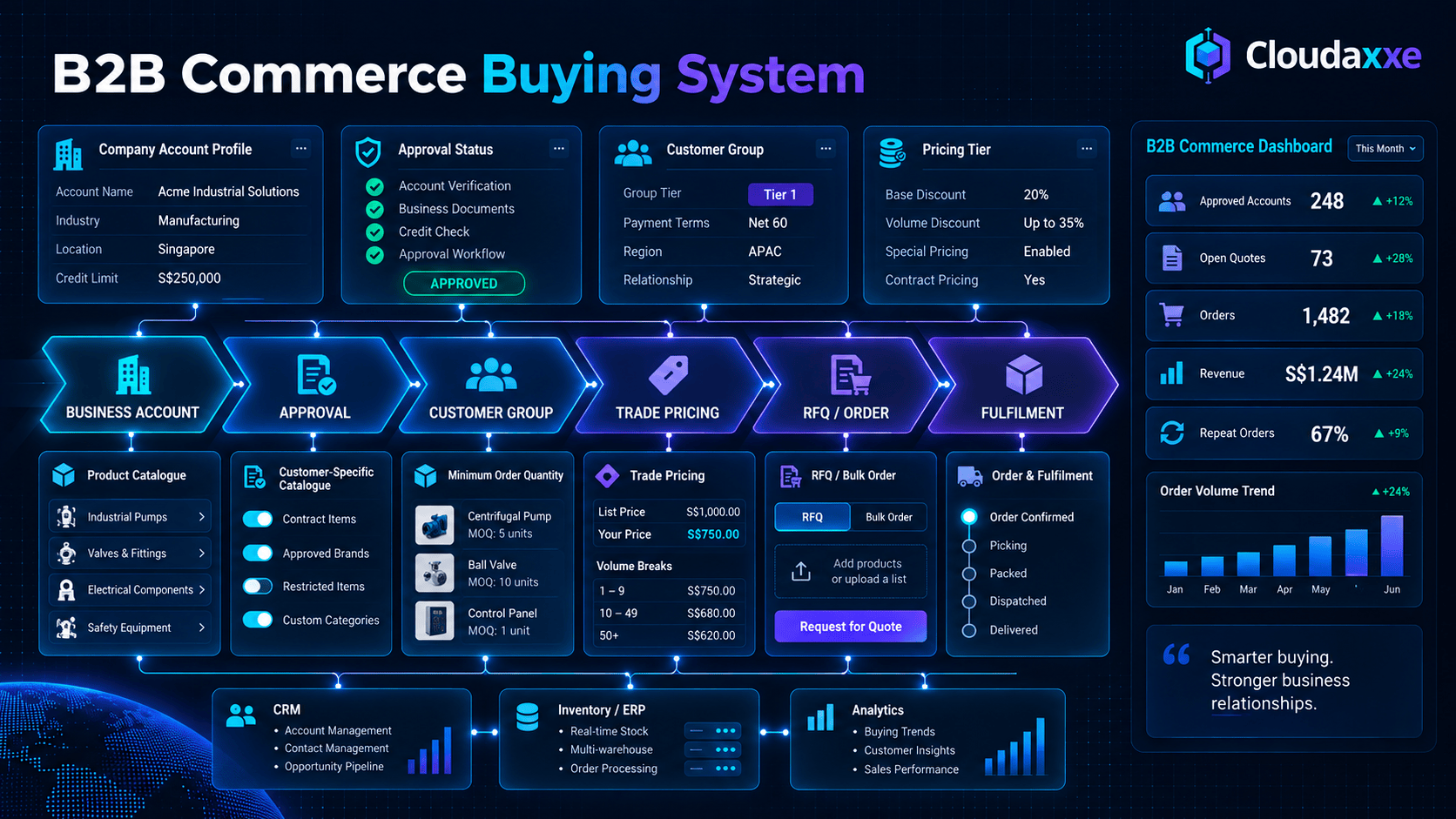
Built for wholesalers, distributors, manufacturers and trade businesses that need approved company accounts, structured pricing, RFQ, bulk ordering and more controlled purchasing workflows.
Starting implementation fee.
Initial products populated.
Categories or collections.
Standard content pages.
Typical working days.
Post-launch support.
For businesses where buying involves accounts, pricing rules and procurement steps.
B2B Commerce is built for organisations that sell to companies, dealers, resellers or trade buyers and need more control than a standard consumer ecommerce workflow provides.

Run trade ordering through a more structured buying system.
For wholesalers and distributors that need account-based pricing, larger order quantities and repeat purchasing.

Make complex product information easier for business buyers to evaluate.
For manufacturers and technical suppliers with models, specifications, product families, datasheets and structured RFQ requirements.

Control access, pricing and purchasing by customer relationship.
For businesses that need approved buyers, dealer groups, reseller access or restricted catalogue visibility.
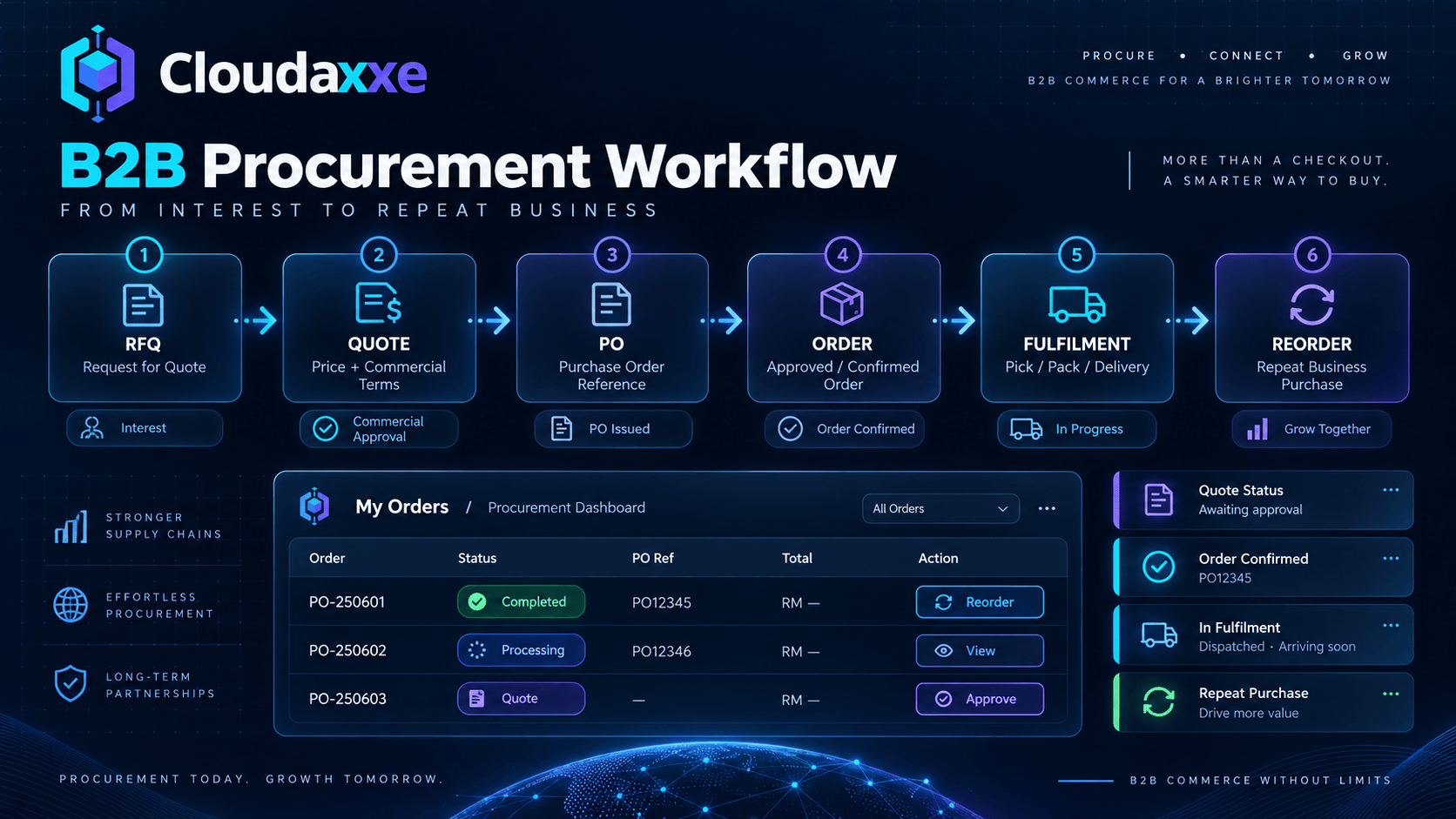
Support the steps between product interest and an approved business order.
For buying processes that involve quotation, PO reference, approval, fulfilment and repeat orders.
Account, pricing and procurement are treated as one connected buying system.
The customer journey starts before checkout. Company access, account approval, commercial rules and repeat purchasing all form part of the architecture.
Register
Business customers enter company and account information through an agreed registration flow.
Qualify
Trade, dealer or business accounts can follow a defined approval process before access is granted.
Price
Approved customer groups can receive suitable pricing and purchasing rules within the agreed scope.
Request / Order
RFQ, MOQ, quick-order and account-based buying support the purchasing process.
Process
Payment, purchase references, stock and fulfilment move into the order workflow.
Reorder
Account history and repeat-order paths support ongoing purchasing relationships.
The platform should fit the B2B operating model, not the other way around.
Customer accounts, pricing rules, catalogue complexity, procurement workflows, integrations and long-term ownership are considered before the platform is confirmed.



Company accounts, procurement and technical catalogue capability around a larger commerce operation.
Package limits describe Cloudaxxe’s initial implementation work, not the technical limits of the selected platform.
Initial Products
Core Content Pages
Account Architecture
Buying Workflow
Business content, account pages, catalogue entries and procurement functions are counted separately.
The core content allowance covers standard company and commercial pages while products, collections and system-generated B2B pages remain outside the count.
Catalogue architecture supports technical evaluation as well as product browsing.
B2B catalogue work is structured around product families, models, specifications and buyer decision requirements rather than product count alone.
Initial Catalogue Population
Up to 300 parent product listings are prepared and populated using agreed source data.
B2B Catalogue Structure
Categories, collections and product families are organised around the agreed catalogue and customer use cases.
Specification Architecture
SKU, model, technical attributes, variants, datasheets, manuals, certifications and related products can be structured where required.
Business buyers often know the model, specification or quantity they need.
Discovery tools are structured for technical and repeat purchasing rather than casual catalogue browsing alone.
Targeted Search
Search paths can support known SKU, model or product-family requirements where the platform allows.
Attribute Filtering
Products can be filtered by relevant technical and commercial attributes within the agreed catalogue.
Product Family Structure
Category, product-family and related-product architecture helps buyers move through complex ranges.
Repeat Purchase Path
Suitable quick-order and repeat-purchase flows can be implemented where supported and agreed.
B2B catalogue quality depends on accurate commercial and technical source information.
Cloudaxxe handles the agreed initial population and structure. The client remains responsible for the accuracy of the product, pricing and commercial rules supplied.
Support standard business purchasing without turning the base package into a custom procurement platform.
Payment, shipping and account-based purchasing are configured around the agreed B2B operating model and standard platform capability.
Up to 3 Standard Methods
Approved payment gateways, bank transfer or other standard supported methods can be configured within scope.
Up to 12 Rules / Zones
Standard regional, value, weight, pickup or agreed business shipping rules where supported.
Business Ordering
PO reference, RFQ or account-based purchasing capability can be included where supported and agreed.
Enhanced Commerce Operations
Stock, backorders, variant inventory and standard order workflow are configured within platform capability.
Business customers need a different account layer from ordinary consumer checkout.
The account architecture can support controlled access, company registration and repeat purchasing within the agreed implementation.
Business Registration
Capture agreed company and buyer information as part of account registration.
Account Review
Business accounts can follow an agreed approval step before trade access becomes available.
Trade Segmentation
Wholesale, dealer, reseller or other agreed customer groups can support access and pricing rules.
Buyer Self-service
Order history, addresses, repeat ordering and account information where supported by the platform.
Commercial rules can change by customer relationship and buying quantity.
Standard B2B pricing and procurement capability is implemented around the agreed platform, customer groups and business rules.
Customer-group Pricing
Business Buying Rules
Account Purchasing
Standard integrations can connect the store without making custom middleware part of the base package.
B2B Commerce includes up to two approved standard integrations where a supported connector or normal implementation route is available.
Customer Relationship
Standard CRM connection readiness for agreed customer, lead or order data where supported.
Operational Connection
Standard supported connector where suitable for the agreed inventory or order workflow.
Finance Connection
Approved accounting-platform connection where a supported standard route is available.
Notification Foundations
Email, notification or standard workflow connections can be included around the delivered scope.
Public catalogue visibility and B2B conversion signals are structured together.
B2B Commerce includes advanced ecommerce search foundations, GEO / AI Search foundations for applicable public content, and up to 16 agreed commerce or conversion events.
Advanced Ecommerce SEO Foundations
Public Content Foundations
GA4 + GTM Measurement
Fully bespoke B2B Commerce UI/UX around the agreed commerce platform.
The interface is designed around company accounts, technical catalogue discovery and procurement rather than adapting a standard consumer storefront with superficial changes.
Account Experience
Company registration, approval, account information and repeat-purchase UX.
Technical Discovery
Product-family, specification, filter and B2B presentation systems.
Buying Experience
RFQ, quantity ordering, account purchasing and commercial decision paths.
Device Adaptation
Desktop, tablet and mobile behaviour checked across the delivered scope.
Accounts, catalogue, pricing and procurement are delivered in sequence.
Scope
Confirm accounts, catalogue, pricing, procurement, platform and integrations.
Architecture
Map B2B catalogue, account, pricing and ordering architecture.
Build
Implement the bespoke storefront, account layer and agreed B2B functions.
B2B QA
Test account access, pricing, RFQ, checkout, tracking and standard integrations.
Launch
Go live, hand over the system and begin 60 days of post-launch support.
Implementation, platform costs and infrastructure remain clearly separated.
Hosted-platform subscriptions remain client-paid. Eligible open-source projects use a higher-performance environment at this level.
Standard Domain Included
One available standard domain can be included and handed over under client control. Premium domains remain separate.
Subscription Separate
Hosted-platform subscriptions, transaction charges and platform-specific fees are paid by the client.
RM1,580 / year
Performance Commerce Hosting for an eligible open-source B2B Commerce implementation.
Ongoing maintenance remains optional and clearly bounded.
Clients can manage the system after the included support period, or retain Cloudaxxe for ongoing technical care.
No Maintenance Plan
RM0Client manages the system after support. Future work is quoted when needed.
B2B Commerce Care
From RM1,200 / monthThe B2B commerce system remains a business asset under the client’s control.
Access and ownership are handed over according to the selected platform, connected accounts and agreed project scope.
Store & Domain
Store administration and domain control where applicable.
Catalogue & Customer Data
Product, company-account, customer and order data remain under client control.
Analytics & Integrations
GA4, Search Console, GTM and connected service accounts remain in client-controlled accounts where applicable.
Documentation & Guidance
Structured handover covers the delivered catalogue, account, procurement and integration components.
The first two months remain part of the delivery.
Included support covers delivered-scope bugs, configuration corrections, account workflow issues, checkout review, standard integration clarification and reasonable handover support.
New products beyond scope, new features, new integrations, new pricing logic, new workflows, ongoing SEO, advertising and custom ERP development remain separate.
Add the capabilities that belong to the business without forcing them into the starting package.
Final pricing depends on platform, data quality, commercial rules and integration complexity.
Products & Migration
Additional products, catalogue migration, data cleanup and larger technical-data work.
B2B Copy & Language
Technical copywriting, category content, localisation and multilingual commerce.
Commercial Logic
Additional customer groups, pricing rules and restricted catalogue logic.
Advanced Buying Rules
Advanced PO, credit terms, approvals and more complex procurement workflows.
Search, Ads & CRM
Ongoing SEO, advertising, CRM automation and lifecycle communications.
ERP, WMS & APIs
Custom ERP, WMS, accounting, marketplace, middleware and API integrations.
Custom pricing engines, deep operational sync and bespoke portals belong above B2B Commerce.
Moving those requirements into the correct architecture early is cleaner than forcing custom software behaviour into a standard B2B commerce implementation.
Custom Pricing Engine
Deep ERP / WMS Sync
Dealer / Distributor Portal
Custom Commerce Logic
70% Deposit → 30% Before Final Handover
Project Commencement
Final Handover
Questions clients usually ask before starting B2B Commerce.
Is B2B Commerce only for wholesalers?
No. It can also suit manufacturers, distributors, industrial suppliers, trade businesses, dealer networks and other companies that sell through account-based or procurement-led buying processes.
Does the 300-product scope include variants?
No. The 300-product scope refers to parent product listings. Standard variants are assessed by catalogue complexity rather than counted as separate parent products.
Can different customers see different pricing?
Yes, where the selected platform supports the agreed customer-group, wholesale or tier-pricing model. More complex contract pricing or custom pricing engines may require additional scope.
Can customers request quotations instead of paying online?
Yes. RFQ capability can form part of the agreed B2B Commerce implementation, including a suitable path from product interest to quote request and subsequent order handling.
Can the store support MOQ and bulk ordering?
Yes, standard minimum-order and quantity-ordering logic can be included where the selected platform supports the agreed requirements.
Can we connect our CRM or ERP?
Yes. The package can include up to two approved standard integrations where a supported connector or normal implementation route is available. Custom APIs and complex synchronisation are separately scoped.
Does every capability shown on this page come with the RM20,000 starting price?
No. B2B Commerce starts from RM20,000. Final functionality is defined around the agreed platform, customer-account model, pricing rules, procurement workflow, integrations and Statement of Work.
Does B2B Commerce include SEO and GEO?
It includes advanced ecommerce SEO foundations and GEO / AI Search foundations for applicable public content. Ongoing SEO, authority building and AI citation outcomes remain separate and are not guaranteed.
Who owns the store and customer data?
The intended model is client-owned handover. Store access, catalogue, customer and order data, domain control and agreed analytics or connected accounts remain under client control where applicable.
When should we choose Advanced Commerce System instead?
Advanced Commerce System is the better starting point when the project requires custom pricing engines, complex approval chains, deep ERP or WMS synchronisation, bespoke dealer portals, custom checkout, headless architecture or substantial custom software logic.
Build a buying system around accounts, pricing and procurement.
B2B Commerce gives wholesalers, distributors, manufacturers and trade businesses a more controlled way to manage business customers, product access, purchasing rules and repeat orders.